kasi,
You said: "Just curious, where in the world do you get these ideas from?
After counting all these years, does it actually, even subjectively, seem to you you spend an equal amount of time in neg TC's as pos TC's?"
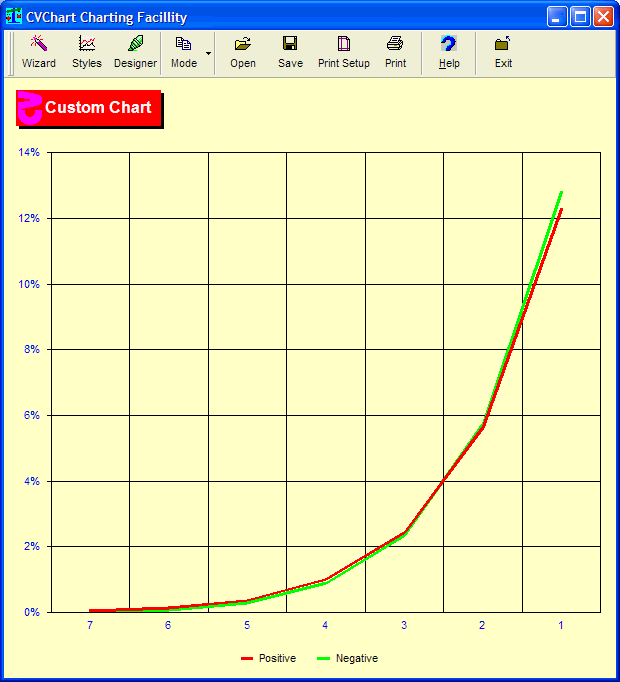
Here is a simple explanation that will prove my point. Let's looks at the simplest balanced count in existence. It will be the same for the most complex count as well. I will use the Ace-Five Count. The 5's are tagged as +1 and the Ace's are tagged at -1. This is actually good enough to beat a (no longer existent) Single Deck S17 DAS game with a non-threatening bet spread. Interestingly, the running count can not be greater than +4 or less than -4. At the "top of the deck" and at any time there is a ZERO True Count (or Running Count) - The probability of a hand having an Ace is the same as the probability of the hand having a 5. Correct ? Therefore the count will move up and down with the depletion of Aces and Fives. By the bottom of the deck the count MUST return to ZERO [if all cards are dealt.] High and Low cards are equally present in the deck or the shoe and the + and - True Counts MUST exist equally. The reason that the Basic Strategist has a losing situation is that he starts off with a disadvantage that we call the "House Advantage". Therefore, the basic strategist will only be "getting the best of it" when the True Count is +1 or +2 (Hi-Lo) depending on the size of the house edge.
You statement about "... subjectively ..." is accountable by what psychologists call "selective memory" If you are a poker player you will recall the bad beats you have suffered but will not recall many of the bad beats that you have been on the winning side of. Ask any ploppy if he or the dealer gets more blackjacks and 9 out of 10 will look at you like you are crazy, as they say, "Of course the dealer always gets more BJ's than I do." OBVIOUSLY, the dealer, you, me, and everyone else receive one "snapper" in every 21 hands. Think about it.
Eshew Subjectivity. Embrace Objectivity.
"...there is a method to scientific thinking and it includes being constantly vigilant against self-deception and being careful not to rely upon insight or intuition in place of rigorous and precise empirical testing of theoretical and causal claims."